
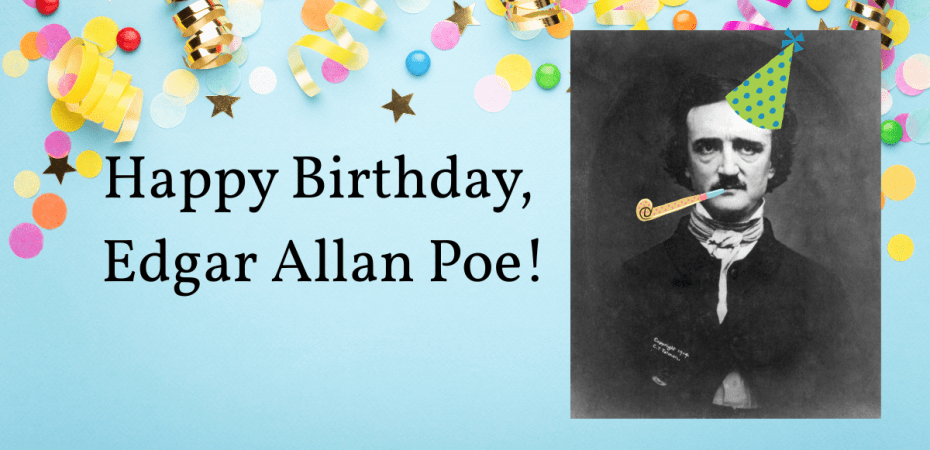
On January 19th, 1809 in a Boston, actors Eliza and David Poe gave birth to a son who would become one of the foremost names in the literary world.
And they named him Edgar.
Since today would have been his 217th birthday, I thougt it would be fun to share some fun facts about Edgar Allan Poe that you may (or may not) know, as well as some quotes and a short list of my favorite works.
Let’s get started!
Ten Facts about Edgar Allan Poe
1. “Allan” is the surname of his foster family, and he took it as a middle name since he was never legally adopted.
2. Poe joined the army at 18 under the pseudonym “Edgar Perry” and did very well, making sergeant major before being honorably discharged in 1829.
3. His story, “The Murders in the Rue Morgue”, was published in 1841 and is hailed as the first modern detective story that features an eccentric genius who solves mysterious crimes. This inspired some of the greatest detectives of all time, such as Sherlock Holmes by Sir. Arthur Conan Doyle and Hercule Poirot by Agatha Christie.
4. When “The Raven” was published in 1845, it became an overnight sensation and made Poe a household name. As a result, he became the first American writer to live completely off of his earnings from writing.
5. Poe married his cousin, Virginia Clemm, in 1836. She was 13, he was 27. They were married for 11 years before she died of tuberculosis in 1847. No children.
6. He had a severe drinking problem, and also racked up thousands of dollars in debt from gambling.
7. Poe believed that “through the calculated use of language one may express, though always imperfectly, a vision of truth and the essential condition of human existence.” (source)
8. On October 3rd, Poe was found delirious near a Baltimore tavern called Gunner’s Hall, which was set up as a polling place for the election. He was dressed in shabby, second-hand clothes that weren’t his own and was sent to the hospital. While at the hospital, Poe drifted in and out of conciousness, often calling out for “Reynolds,” a mystery figure who remains unidentified to this day.
9. Edgar Allan Poe died in the Washington College Hospital in Baltimore on October 7, 1849. His last words are recorded as “Lord help my poor soul,” and his cause of death is listed as inflammation of the brain, but the reason is largely unknown.
10. According to the Smithsonian Magazine, there are nine theories for what happened to Poe during his last days:
- A jilted lover had him beaten
- Cooping (a method of voter fraud practiced by gangs in the 19th century where an unsuspecting victim would be kidnapped, disguised and forced to vote for a specific candidate multiple times under multiple disguised identities)
- Alcohol poisioning (due to his alcohol addiction)
- Carbon Monoxide poisioning from coal gas (debunked)
- Heavy Metal poisioning (specifically mercury, which he was exposed to during a bout of cholera)
- Rabies (theorized during a 1996 clinical pathologic conference- most symptoms fit)
- A brain tumor (which could be responsible for his erratic behavior)
- The flu, which turned into pneumonia (he complained about being sick in the days before his discovery)
- Murder (supposedly by the brothers of his then-fiance, Sarah Elmira Shelton, who were against the marriage- as theorized by author John Evangelist Walsh)
Despite these theories, the true cause of Edgar Allan Poe’s death is still a mystery.
Quotes by Edgar Allan Poe
“Most writers—poets in especial—prefer having it understood that they compose by a species of fine frenzy—an ecstatic intuition—and would positively shudder at letting the public take a peep behind the scenes, at the elaborate and vacillating crudities of thought—at the true purposes seized only at the last moment—at the innumerable glimpses of idea that arrived not at the maturity of full view—at the fully matured fancies discarded in despair as unmanageable—at the cautious selections and rejections—at the painful erasures and interpolations—in a word, at the wheels and pinions—the tackle for scene-shifting—the step-ladders and demon-traps—the cock’s feathers, the red paint and the black patches, which, in ninety-nine cases out of the hundred, constitute the properties of the literary histrio.” –The Philosophy of Composition, published 1888.
“Newspaper editors seem to have constitutions closely similar to those of the Deities in “Walhalla,” who cut each other to pieces every day, and yet get up perfectly sound and fresh every morning.”- Fifty Suggestions, Part 1, published 1849.
“That poets (using the word comprehensively, as including artists in general) are a genus irritabile, is well understood; but the ruby, seems not to be commonly seen. An artist is an artist only by dint of his exquisite sense of Beauty — a sense affording him rapturous enjoyment, but at the same time implying, or involving, an equally exquisite sense of Deformity or disproportion. Thus a wrong — an injustice — done a poet who is really a poet, excites him to a degree which, to ordinary apprehension, appears disproportionate with the wrong. Poets see injustice — never where it does not exist — but very often where the unpoetical see no injustice whatever. Thus the poetical irritability has no reference to “temper” in the vulgar sense, but merely to a more than usual clear-sightedness in respect to Wrong”- Fifty Suggestions, Part 1, published 1849.
“They who dream by day are cognizant of many things which escape those who dream only by night.”- from the short story “Eleonora,” published 1841.
“If you wish to forget anything upon the spot, make a note that this thing is to be remembered.”- From the introduction to Marginalia, installment I, published 1844
My Favorite Poe Works
Poe is one of my favorite authors, but these are the works I come back to again and again.
Short Stories
The Masque of the Red Death– the red death visits a nobleman and his house of revelry. Classic horror with beautiful (and unsettling) imagery.
The Cask of Amontillado– a man uses a legendary wine to take his revenge. Funny and horrifying.
The Tell-Tale Heart– a man is driven mad by the guilt of his crimes. Classic horror.
The System of Doctor Tarr and Professor Fether– the innmates have taken over the asylum! Funny and odd.
Poems
Happy Birthday, Edgar Allan Poe!
To learn more about him and his contributions to literature, check out The Poe Museum, The Poetry Foundation, and The Edgar Allan Poe Society of Baltimore.
What are your favorite Poe works? Let me know in the comments!
Discover more from Erynn Crittenden
Subscribe to get the latest posts sent to your email.
 Erynn Crittenden